One machine for the Burleson space your ductwork never reached
Shop out on the acreage, a garage that became an office, an addition the old system was never asked to carry. A ductless system gives that space its own thermostat without opening up an attic to get there.
What people are actually describing when they call
The conversation almost never opens with the equipment. It opens with a complaint about one part of the house. A shop on a couple of acres that hits an unusable temperature by mid morning. A two car garage finished out into a workshop, where the guy standing in it wants to keep working past ten in the summer. An upstairs room in one of the two story builds that went up during the 2000s wave, where the downstairs thermostat is satisfied and nobody upstairs agrees with it.
Burleson generates a lot of that kind of call, and the reason is in the housing mix. Neighborhoods from the seventies and eighties, a heavy run of 2000s construction, and new builds still going in along the corridors, plus acreage lots with outbuildings that were never on any duct plan to begin with. Every one of those groups produces a different version of the same request: give me control over that one space without a project that swallows the whole house.
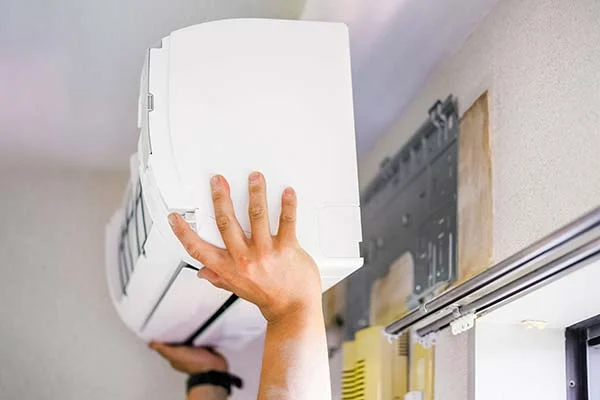
Where ductless beats adding duct
Extending a duct run is the instinctive answer. It is also the answer that quietly fails most often, because the trunk it comes off was sized for the original floor plan and nothing since.
Tap a new branch into a plenum that is already working at its limit and two things happen at once. The new space gets a trickle of air that never satisfies it, and every register it used to share with loses pressure. On a long attic run through a July attic, whatever cooling started at the plenum has largely evaporated by the time it exits the boot. Nobody is happy and the fix cost real money.
The other half of the problem is that this is a zoning question wearing a capacity costume. Buying a larger central unit to bully more air into a stubborn room overcools the rest of the house and short cycles the compressor while it does it. A dedicated head answers only to the space it hangs in, which is why the shop can run at 68 through a January cold snap without anyone in the main house noticing a thing.
The equipment is a heat pump, so it reverses and heats the same space it cooled in August. Johnson County winter is short, with fronts that drop temperatures thirty degrees in an afternoon and a handful of nights that genuinely bite, which is duty a heat pump handles well. Completed work sits in the gallery, and the full Burleson service list covers everything else we run out here.
The install decisions you will live with for years
Bolting up the equipment is the straightforward part of the day. What determines whether you are still happy in year five is where the outdoor unit lands, how the lineset travels and gets covered, and what happens to the condensate. On an acreage lot the outdoor unit has room to breathe, which is a gift, but it still needs a level pad set high enough that a spring downpour running across open ground does not undercut it, and it needs to sit away from the bedroom windows and the porch where people actually sit.
Lineset routing is where a job either disappears into the house or announces itself from the driveway. A run down an exterior wall gets a proper cover, squared to the trim lines, not a length of tubing zip tied to the siding.
Condensate deserves a decision, not an improvisation. A head on an outside wall drains by gravity through the same penetration the lineset uses. A head on an interior wall needs either a routed drain to a line that already exists or a small pump, and that pump goes somewhere a person can reach it later instead of behind drywall somebody will have to cut. That gets settled during the walkthrough.
If the real problem turns out to be the central system serving the main house, that is a separate conversation and it lives on the Burleson AC installation page. Homes here often end up doing both, a year or two apart. Start the conversation on the contact page.
What install day looks like from your side of it
Nothing gets ordered until the walkthrough is done. We measure the space, look at what it is built out of, check the wall the head would hang on and the ground the outdoor unit would sit on, and then run the load calculation. You get told the capacity that space actually needs and why, in normal language, before any model number comes up. That conversation is the part most homeowners have never been given, and it is the part that determines whether you like the result.
On the day itself, a single zone starts with the wall penetration and the mounting plate, then the head goes up, the lineset gets run and covered, the outdoor unit gets set on its pad and connected, and the line gets pulled into a deep vacuum before any refrigerant moves. That vacuum step is where corner cutting hides, because a system that skipped it works fine for a season and then does not. The charge gets weighed to the manufacturer’s number for the actual line length rather than topped off by feel.
Before we leave, the system runs in both cooling and heating while we check the readings, the condensate path gets tested with water rather than assumed, and you get walked through the remote, the filter cleaning schedule, and what a normal defrost cycle sounds like in winter so it does not alarm you the first cold morning. Model, serial, and warranty registration go on the paperwork you keep. Financing through Synchrony and Wisetek is available on the multi zone jobs if the timing is awkward.
Straight answers on Burleson mini split work
More 2L help close by: AC repair, furnace repair, emergency AC repair, and ductless installation across the whole service area. Or call (214) 717-3959 and describe the room. The owner picks up.
Will one head keep a metal shop on acreage comfortable in August?
It can, if the number is honest. A metal building takes heat through the skin, the roof, and any uninsulated door, so the load runs well above what the floor area suggests. We measure the building and calculate it. Insulating the roof deck first almost always lets a smaller unit win outright.
Does this replace my heater out there too, or is that separate?
It replaces it. The system is a heat pump, so the same box that cooled the space in July warms it in January. Our winter here is short with a few hard fronts, which is comfortable territory for a heat pump. One machine covers both directions, no separate heater in the shop.
Can you condition a garage conversion without touching the main system?
Yes, and that is usually the point of doing it this way. The garage gets its own outdoor unit, its own head, and its own remote, completely independent of the house system. Nothing about your existing thermostat, ductwork, or equipment changes, and the main house never gives up capacity to serve the new room.
How do I choose between one multi zone system and separate singles?
Layout decides it. A multi zone outdoor unit feeds two to five heads from one set of penetrations, which is tidy and saves wall space. Separate singles are simpler to service and one failure does not darken the other rooms. Spaces far apart usually favor singles. We lay both against your floor plan.
What about the upstairs bedrooms in a two story build?
Sometimes a head is right, often it is not. If the duct upstairs is undersized or leaking, sealing and balancing fixes the complaint for less money and does not put equipment on a bedroom wall. We check that first and tell you what we find, even when the answer is a smaller job than you called about.
How many days should I plan on being without the space?
A single zone is normally one day, start to finish, and the room is usable that evening. Multi zone typically runs two, depending on how far the linesets have to travel and what they pass through. We do not compress the routing to save an afternoon, because that shortcut is the part you would notice for years.
Got a Burleson room or shop the main system has given up on? Let’s go measure it.
Book a Service Call