Cedar Hill’s AC quit. Let’s find out why.
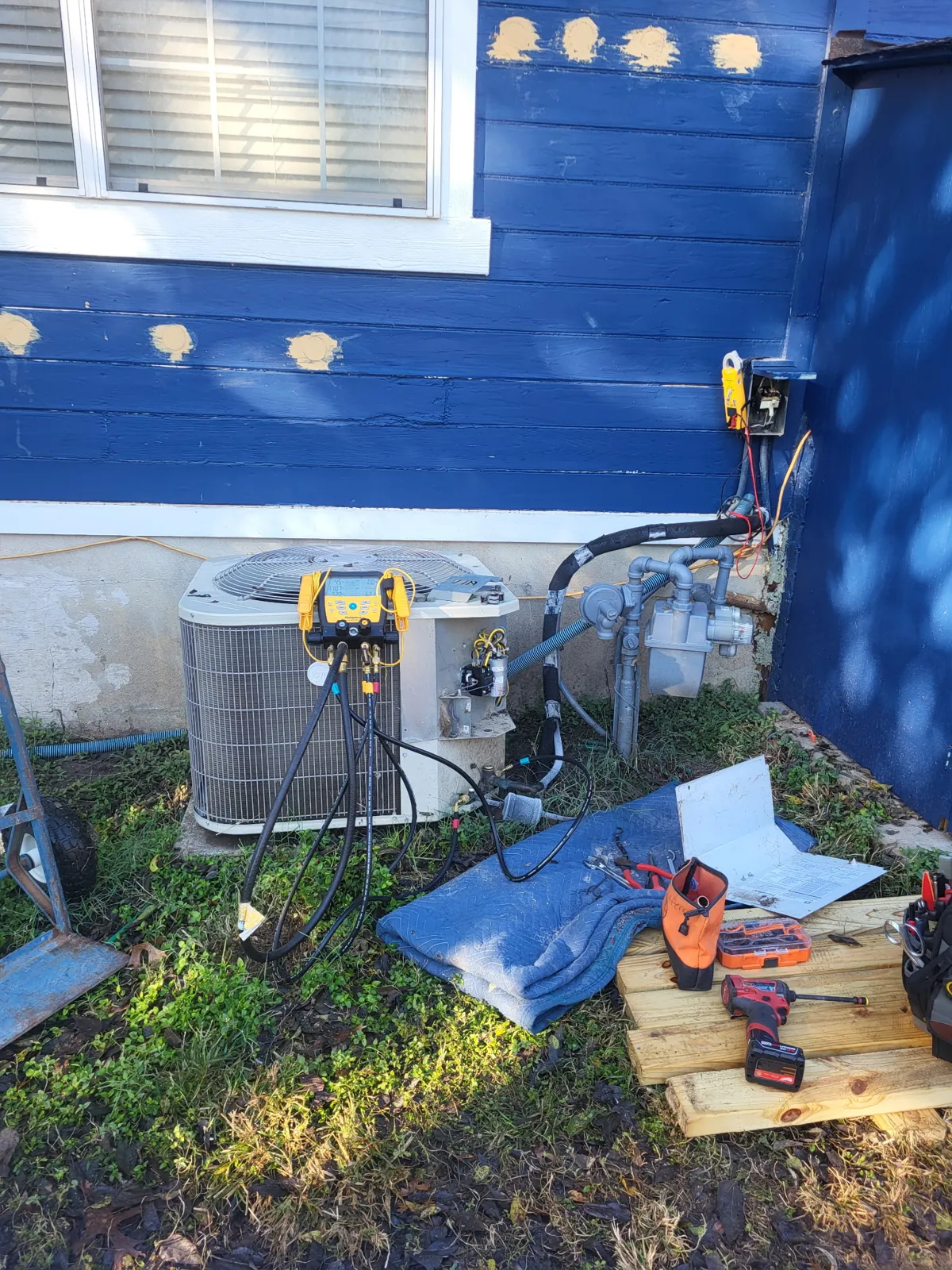
A hot house on the escarpment in August is not a mystery worth guessing at. We come out from Midlothian, put meters on the system, and tell you what actually failed before anybody talks about parts.
What actually breaks in a 100 degree stretch
North Texas summers do not ease into anything. We get long runs where the temperature sits over a hundred for days at a time, and a Cedar Hill air conditioner that was merely tired in June becomes a dead air conditioner by the second week of that. The parts that give out are predictable once you have seen enough of them. Capacitors swell and lose the punch that starts the compressor. Contactors pit until they stop making clean contact. Condenser fan motors seize, and the whole system goes down on high head pressure within minutes.
Then there is the slow refrigerant leak, which is the sneakiest one. It does not announce itself. The house just gets a little less comfortable every summer until one July the system runs all afternoon and never satisfies the thermostat. That is not a dying compressor in most cases, and anyone who tells you otherwise without putting gauges on it is guessing at your expense.
Still blows cold, just not cold enough
This is the single most common call we take from Cedar Hill, and it almost never means what homeowners fear it means. A system that still produces cold air has a working compressor. What it usually has instead is a charge problem or an airflow problem, and those are two very different repairs with two very different price tags, which is exactly why the diagnosis has to come first.
On the airflow side, the culprits are boring: a filter nobody has changed since spring, an evaporator coil packed with dust, a blower wheel caked enough to move a fraction of the air it should. Cedar Hill adds its own wrinkle here, because plenty of lots back up to wooded ground near the state park and Dogwood Canyon, and condensers under that kind of tree cover collect leaf litter and cottonwood fuzz across their coils all season. A condenser that cannot dump heat will run and run without ever getting the house where you set it.
On the charge side, low refrigerant means a leak, full stop. Refrigerant is not consumed the way gas is. If the charge is low, it went somewhere, and topping it off without finding the leak is renting yourself another summer at best. We find the leak, show you where it is, and let you decide what makes sense from there.
Attics, hills, and equipment that is getting old
Cedar Hill sits high, on ground noticeably hillier than the flat prairie north of it, and that terrain gave us a housing mix worth understanding. There are 1970s and 80s originals here, and then a heavy wave of subdivision building through the late 90s and 2000s. Do the arithmetic on that second wave and a very large share of Cedar Hill systems are now at or past the service life anybody would call typical.
The 2000s builds tend to put the air handler in the attic, which matters more here than most people realize. A North Texas attic can push past 140 degrees on a July afternoon. Every piece of that equipment lives in it: the blower, the coil, the drain pan, the flex duct, the control board. Heat like that ages plastics, dries out seals, and turns a marginal capacitor into a failed one years early. When we work an attic system in Cedar Hill, that environment is part of the diagnosis, not an afterthought.
Finished work from around the area sits in the gallery, and the contact page books a visit in about a minute.
More help nearby: Emergency AC Repair in Cedar Hill · All Cedar Hill HVAC services · AC Repair across our whole area
The repair versus replace conversation, done honestly
On an aging Cedar Hill system this question comes up for real, and it deserves a real answer instead of a sales pitch. Repair first is the default here. If a part fixes it and the rest of the system has life left, that is what you will hear, and plenty of homeowners have kept units running for years past the point another company would have condemned them.
When repair genuinely stops making sense, you get that laid out plainly too: the age of the equipment, what has already failed, what is likely next, and what the repair buys you in time. Jimmy started this company because he did not like where the industry was heading with all the used car salesman behavior, and the whole point is that the twenty years of experience shows up in your house instead of at a sales desk. Nobody here earns anything extra by finding you a bigger problem. If the honest answer is that your system has another five summers in it, that is the answer you get.
Winter counts too, by the way. Those sudden blue norther cold snaps that drop us forty degrees overnight are what expose a heating side nobody has looked at since spring, and the same repair first thinking applies there.
Cedar Hill AC repair questions, straight answers
Something more specific going on? Call (214) 717-3959 and describe it. You will talk to the owner, not a call center.
My AC runs constantly but the house never gets cool. What is that?
Usually charge or airflow, not the compressor. A system that still makes cold air has a working compressor. Check the filter first, then call us. We will read the actual pressures and temperature split and tell you which of the two it is rather than guessing.
How fast can you get to Cedar Hill in the middle of summer?
Fast. Cedar Hill borders Midlothian, so it is one of the closest cities we serve and it sits well inside our regular loop. Cooling failures get priority in a Texas July, and genuine emergencies reach the 24/7 line around the clock.
My air handler is in the attic. Does that make repairs harder?
It makes the working conditions worse, not the repair. Attic units are common in the late 90s and 2000s Cedar Hill builds, and attic heat is hard on them, so we check the drain pan, the coil, and the duct connections while we are up there instead of only the part that failed.
My unit is around twenty years old. Is it worth repairing?
Often, yes. Age alone does not condemn a system. What matters is what failed, what shape the rest of the equipment is in, and how much time the repair realistically buys you. You get that math straight, and the decision stays yours.
Somebody added refrigerant last summer and it is low again. Why?
Because it leaked. Refrigerant does not get used up, so a low charge always means it escaped somewhere. Adding more without locating the leak just resets the clock. We find it, show you the spot, and talk through your options from there.
Which brands do you work on?
All the major residential brands: Trane, Carrier, Lennox, Goodman, Rheem, American Standard, Amana, and the rest. Twenty plus years across North Texas means Jimmy has had his hands on just about everything installed around here.
Will you show me the part that failed?
Yes, and we would rather you look at it. Seeing the swollen capacitor or the burnt contactor yourself beats taking anybody’s word for it, and it is how we would want to be treated in our own homes.
Hot house in Cedar Hill? The owner answers the phone.
Book a Service Call