Putting in a furnace the house can actually use
Fall is furnace season around Cleburne, and the January cold snaps have a habit of finding every system that skipped it. When yours is finished, we size the replacement to the house you live in today, fit it to the coil and duct already there, and prove the first fire with gas pressure and carbon monoxide readings before anybody calls the job done.
Attic furnace or hallway closet, and why it changes the job
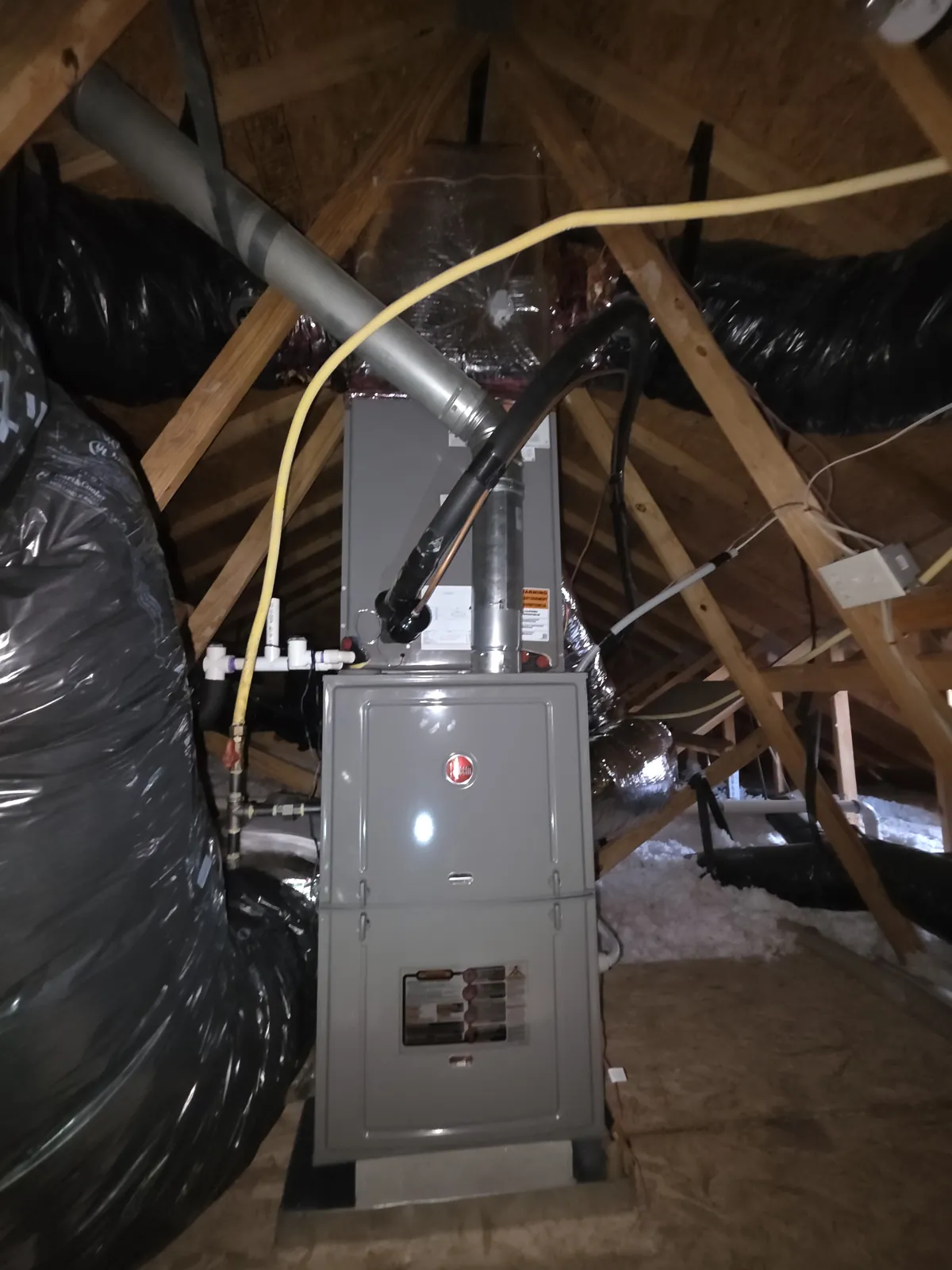
Cleburne furnaces tend to live in one of two places, and each brings its own install day. Some homes keep the furnace in a hallway closet, standing upright with the flue climbing straight through the ceiling and the return pulling air from a grille in the door or the wall beside it. Others hang the equipment in the attic, where the furnace sits with its coil cabinet attached and flex duct fanning out in every direction.
A closet job is tight work. The new unit has to fit the footprint, the door still has to close, and the closet needs enough combustion air for the burners to breathe. A replacement furnace can be a different height or width than the box coming out, so we measure the space before anything gets ordered instead of discovering a problem with the new unit sitting in the driveway.
An attic job trades tight walls for heat and access. Everything travels up through the hatch, the platform has to carry the weight, and a high-efficiency unit needs a condensate path that will not overflow into the ceiling below. We look at the platform, the secondary pan, and the drain route before the old furnace comes down, because those are the pieces that cause trouble a year later.
Venting, combustion air, and the gas line
A gas furnace is only as safe as the route its exhaust takes out of the house. On every replacement we look hard at the flue: its size, its pitch, its joints, how it passes through the roof, and whether it still suits the unit going in. A standard-efficiency furnace sends hot exhaust up metal pipe. A high-efficiency furnace pushes cooler exhaust through PVC and drains condensate as it goes. Moving from one to the other changes the venting completely, and you will hear that before the order is placed.
Burners also need air to burn. A furnace boxed into a small closet, or tucked into a corner where fresh air cannot reach it, can starve itself, and that shows up as poor combustion, soot, and in the worst case carbon monoxide. Checking combustion air is part of how we install, on every furnace, before the burners ever light.
Then the gas itself. We check the connection, the shutoff, and the sediment trap, and the gas pressure gets set at startup with a manometer reading instead of trust in the factory setting. If you are still weighing the electric option, heat pump installation in Cleburne walks through how the two compare in this climate. A new furnace feeding leaky duct wastes part of the upgrade, so duct sealing in Cleburne is worth a look on the same visit.
Before anything gets replaced
Sizing to the coil and duct you already own
The fastest way to end up with the wrong furnace is to read the label on the old one and order the same number. That number was picked for the house as it stood back then. Insulation gets added, windows get swapped, rooms get finished out, and a furnace sized for a draftier version of your home may short cycle in the one you have now. We work out what the house actually loses on a cold night and size the new unit to that.
The furnace also has to get along with the cooling coil sitting on it and the duct attached to both. One blower moves air for heating and for cooling, so a furnace that cannot push enough air across your existing coil hurts the summer as much as the winter. We confirm the cabinet widths line up, that the blower can handle the coil and duct, and that the temperature rise across the heat exchanger lands inside the range printed on the unit.
If the coil or the duct turns out to be the real limit, you hear it before anything is ordered. Sometimes the right call is a furnace a size away from what you expected, and sometimes it is fixing a return that has been choking the old unit for years. Photos of finished jobs are in our gallery, and you can book a visit online.
The Johnson County seat is a clean run down US-67 for us. See what else we do in town on the Cleburne service page, the rest of our Johnson County coverage, or furnace installation across every area we serve.
Startup day, and what you see before the truck leaves
A straight replacement begins early with the gas shut off and the old furnace disconnected and carried out. The new unit goes onto the existing footprint or a corrected one, the flue and gas line get connected, the coil and plenum are sealed to the cabinet, and the condensate gets routed where it belongs. Then comes the moment that matters most, the first fire.
At startup we read and set gas pressure, measure the temperature rise, and run a combustion check that includes carbon monoxide in the flue. The safety controls get tested, the flame sensor and limit switch among them, and we confirm the thermostat calls for heat the way it should. A furnace can light and blow warm air while burning poorly, and only the instruments tell those two apart.
Before we pack up, you get shown the readings and what they mean, where the filter sits and how often to change it, where the gas shutoff is, and what a normal start sounds like so an odd one stands out. Jimmy has spent twenty years in North Texas houses, and he would rather spend that experience teaching you your own furnace than pitching you something extra. That is what he means when he says the experience belongs in your house instead of at a sales desk.
Just bought an older Cleburne home with a furnace history nobody can explain? HVAC inspections in Cleburne tell you what you are working with before you spend a dime on replacement. On a newer build, new home HVAC inspections in Cleburne check the furnace and its duct while the builder warranty still has teeth. And when a replacement lands in a bad month, financing through Synchrony and Wisetek spreads the cost over time.
Furnace replacement questions we hear in Cleburne
Something about your setup that is not covered here? Call (214) 717-3959. Jimmy answers, and he will tell you straight whether it sounds like a repair or a replacement.
Should my new furnace be the same size as the old one?
Not automatically. The old size was chosen for the house as it was, and most homes have changed since. We size to what your house loses on a cold night, then check that the choice works with your coil and duct. Sometimes that lands on the same size, and sometimes it does not.
Can the new furnace go where the old one was?
Usually, with some adjustments. Closet installs need the new unit to fit the footprint and still get enough combustion air. Attic installs need a sound platform, a secondary pan, and a clean drain route. If the venting has to change for the new equipment, we explain why before ordering anything.
What is a combustion check, and why does it matter?
It is a test of what the burners are actually producing, read with an analyzer in the flue, carbon monoxide included. A furnace can light and blow warm air while still burning badly. We run the check at startup so you know the new unit is burning cleanly from its first day.
Do I need to replace my AC coil at the same time?
Not always. If the existing coil fits the new cabinet, is in good shape, and works with the blower, it can stay. If it is undersized, damaged, or mismatched to the outdoor unit, keeping it costs you comfort in both seasons. We tell you which situation you are in before you decide.
What should I expect on install day?
An early start, the gas shut off, and the old unit out before the new one goes in. You will know the plan beforehand, including anything unusual about the venting or the drain. The day ends with the readings shown to you, the heat running, and the work area cleaned up.
Is a heat pump a better choice than a new gas furnace?
It depends on the house. Many older Cleburne homes already have gas service, which makes a furnace the natural replacement. All-electric homes are a different conversation. We lay out both options honestly, with the reasoning attached, and the choice belongs to whoever pays the utility bills.
Furnace showing its age ahead of winter? Have Jimmy look it over this fall.
Book a Visit